 Request A Quote
 Let's Talk
 Mail Us
 WhatsApp
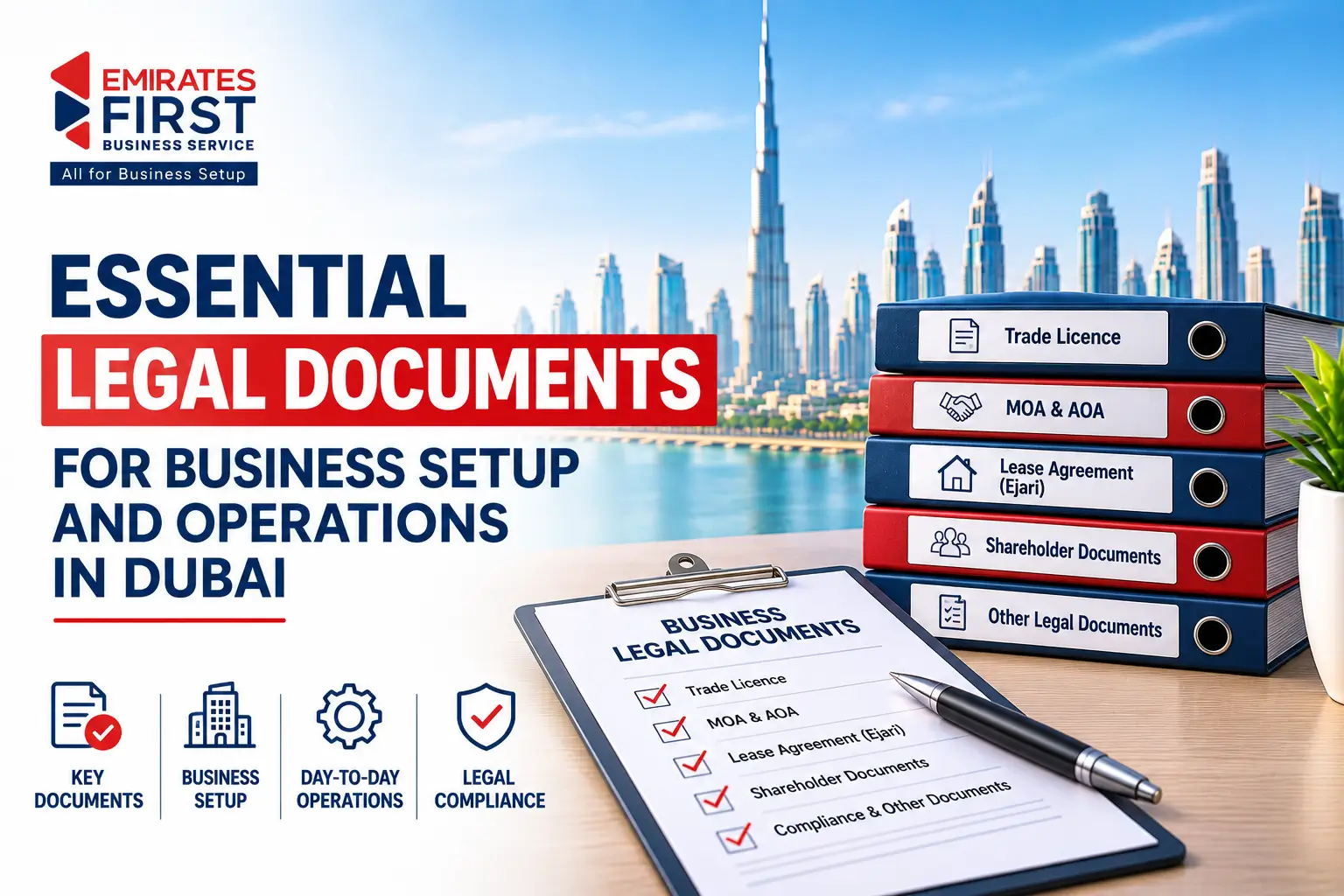
Starting a company in Dubai is exciting. Then the paperwork arrives, and most new owners are not sure which documents to keep ready or when. This guide explains the legal documents for business setup in Dubai, following your journey from setup to registration to daily operations.
New here? Read how to start a business in Dubai first, or see business setup in Dubai and Dubai company formation. After gaining insight into all of these, let’s make the essential documents ready.
No business needs every document on this list. It depends on your company structure, activity, and licensing authority.
Legal documents prove who owns your company, what it may do, and that it follows the rules. Without them, you cannot get a license, open a bank account, or hire staff. The legal requirements for business in UAE ask for proof at every stage, and the legal documents for business setup in Dubai are where that proof begins.
| Stage | Key documents |
|---|---|
| 1. Company setup | Passport copies, initial approval, trade name certificate, Memorandum of Association (MOA), office lease |
| 2. After registration | Trade licence, establishment card, UBO records, tax registrations |
| 3. Daily operations | Employment contracts, visa papers, agreements, accounting records |
The documents required to start a business in Dubai usually include passport copies, an initial approval, a trade name certificate, an MOA, and an office lease. If you are gathering business setup documents that Dubai authorities will accept, start with this core set. It usually doubles as your Dubai company registration documents. Mainland licenses come from the Dubai Department of Economy and Tourism (DET), while free zones issue their own. Check the latest list on the DET website and the UAE government guide to setting up a business.
Every shareholder and manager needs valid passport copies, and residents also need to share an Emirates ID and visa copy. These shareholder identification documents show who is behind the company. Blurry or expired copies cause delays.
Needed by most companies. This is the authority's first go-ahead for your activity, so it works as your business activity approval. It is not the license yet.
Needed by all companies. It keeps your company name reserved for you. Trade name registration also confirms the name follows the authority's rules.
Needed by most companies, not all. The MOA is the main legal agreement. It lists the owners, shares, capital, and activities, while the Articles of Association (AOA) explain how the company runs. Mainland limited liability companies (LLCs) need an MOA. A sole establishment may not.
A shareholder agreement is a separate, optional contract about profit sharing and exits, useful with two or more owners.
Needed by most companies. Your office lease agreement, also called a tenancy contract, proves your business address. It is then registered on Ejari through the Dubai Land Department, and you receive the Ejari certificate.
Only when needed. A board resolution is a written decision by the owners, common when one company owns another. A Power of Attorney (POA) lets someone else sign for you, which helps when the owner lives outside the UAE.
Only for regulated activities. Healthcare, education, food and financial services often need an extra permit.
Not Sure Which Documents Your Dubai Business Needs?
Get your documentation right from the start. EFirst helps you identify, prepare and organise the documents required for your business activity and company structure.
After registration, you usually need the trade licence, establishment card, UBO records, bank papers, and tax registrations. These are your UAE business compliance documents.
Mandatory. The trade licence is your permission to operate. Keep it together with the commercial registration and the company incorporation certificate, because banks and clients ask for all three. These are the business licence documents Dubai companies show most often.
Needed to hire staff. It is your company record with the labour and immigration systems, and you cannot sponsor an employee visa without it. Mainland companies deal with immigration authorities and the Ministry of Human Resources and Emiratisation (MOHRE), while free zone companies usually use their free zone authority. Check the steps with the Federal Authority for Identity, Citizenship, Customs and Port Security (ICP) and theMOHRE service directory.
Mandatory for licensed companies. A UBO declaration names the real people who own or control the company. Under Cabinet Decision No. 58 of 2020 and later updates, companies keep UBO and shareholder registers and file them with the licensing authority. A UBO is generally anyone holding 25% or more. The Ministry of Economy and Tourism works with licensing authorities on these rules. The Dubai International Financial Centre (DIFC) and Abu Dhabi Global Market (ADGM) follow their own rules.
Needed to open an account. Banks usually ask for the trade licence, MOA, lease, shareholder passports and Emirates ID.
Mandatory for most companies. Register online on the Federal Tax Authority (FTA) EmaraTax portal, where a UAE Pass login is commonly used. The FTA asks for incorporation papers, a valid trade licence and ID documents of owners and authorised signatories. Free zone companies must register too. After approval, you get a corporate tax certificate.
According to the FTA, taxable income up to AED 375,000 (UAE dirhams) is taxed at 0%, and income above that at 9%. Qualifying free zone income may be taxed at 0%. Need help? See corporate tax registration support.
Only if your turnover requires it. The FTA says VAT registration is mandatory above AED 375,000 in taxable supplies and imports over 12 months, or when you expect to cross it within 30 days. Voluntary registration starts at AED 187,500 in supplies, imports or expenses. The documents are similar to corporate tax, plus turnover details.
Daily operations need contracts, visa papers, accounting records, insurance and permits. These are the legal documents for companies in UAE that you will use again and again.
Mandatory for every employee. Mainland companies file each written employment contract through MOHRE. Free zone companies usually follow their free zone authority, while DIFC and ADGM have separate employment rules. Labour registration details must match the contract.
Needed for each employee.Employee visa documents include a passport copy, photo, medical fitness result, Emirates ID application and entry permit. The establishment card must be active first.
Strongly advised. A written agreement should state the price, payment dates, delivery terms and what happens if something goes wrong.
Mandatory.Keep invoices, receipts and accounting records. The FTA expects corporate tax records to be kept for at least seven years after the tax period. VAT records have their own period, so check with the FTA.
Health cover is usually required for employees in Dubai.
Only for regulated activities.These permits need regular renewal, so set reminders before they lapse.
The basics are similar. The difference is who issues the papers and whose rules apply. Free zones also differ on the company formation documents UAE applicants must submit.
| Document / Requirement | Mainland | Free Zone |
|---|---|---|
| Trade licence | Relevant mainland authority (DET in Dubai) | Relevant free zone authority |
| MOA / AOA | Depending on legal structure | Depending on legal structure and authority |
| Office / lease documents | As required by the licensing authority | According to free zone requirements |
| Additional approvals | Depending on business activity | Depending on business activity |
| Corporate documents | Based on company structure | Based on free zone regulations |
Read more on mainland company formation and free zone company formation.
Ready to Register Your Business in Dubai?
Skip the paperwork confusion. Let EFirst assist with document preparation, trade licence applications, company registration and government approvals.
Foreign company documents need attestation when they are issued outside the UAE and submitted to a Dubai authority. It proves the document is genuine. The need depends on the document and authority.
Notarised documents from abroad usually follow this path:
Foreign parent-company documents for some Dubai branch applications may need all five steps. Rules on apostille can differ by country, so confirm with the Ministry of Foreign Affairs on the UAE Government portal before you start.
Watch out for these slips:
Use this checklist to track your legal documents for business setup in Dubai and beyond.
Keep Your Dubai Business Compliant Without the Administrative Stress
From visa processing and licence renewals to PRO services and government documentation, EFirst helps keep your business administration on track.
For most companies, the legal documents for business setup in Dubai are passport copies, shareholder ID, initial approval, a trade name certificate, an MOA and an office lease. Some activities need extra permits.
No. It depends on the legal form. LLCs need one, while a sole establishment may not.
Often yes, for companies with a physical office in Dubai. Some free zone setups with flexi-desks work differently.
Usually yes. They may need notarisation, embassy attestation, Ministry of Foreign Affairs attestation and Arabic translation. It varies by document and authority.
It is a record of the real people who own or control a company, filed with the licensing authority and kept updated.
The FTA asks for incorporation papers, a valid trade licence and ID documents of owners and signatories. Registration is online through EmaraTax.
Yes, in some areas. Each free zone authority sets its own rules.
Keep digital and printed copies in one place, track expiry dates, and update records after any ownership or activity change.
Document rules change, and small mistakes slow things down. EFirst helps entrepreneurs, startups and existing owners with document preparation, company registration, licensing and ongoing admin work. Its PRO services team also handles visas, renewals and government follow-ups.


© 2026 Emirates First Business Service LLC. All Rights reserved.


