 Request A Quote
 Let's Talk
 Mail Us
 WhatsApp
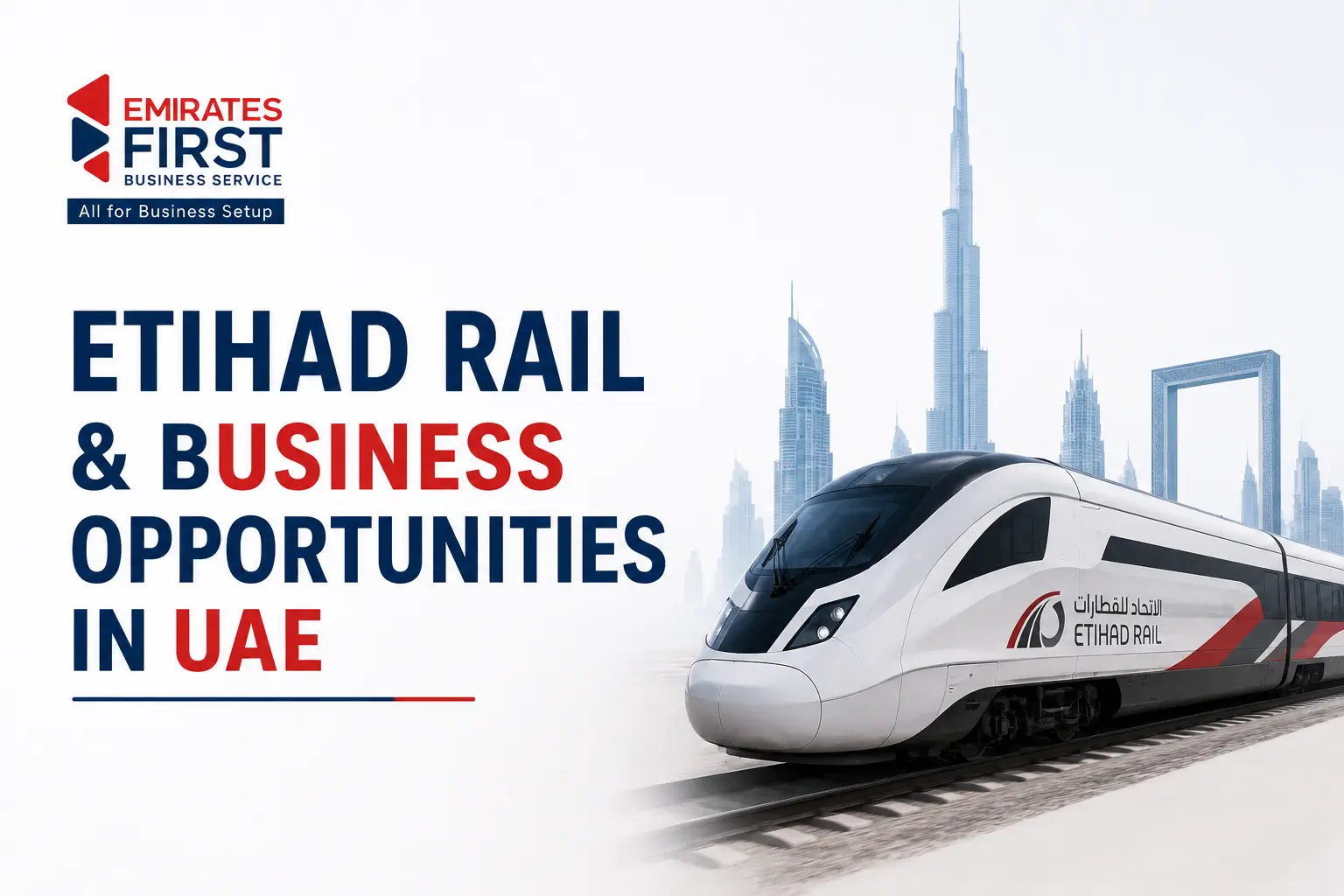
Etihad Rail is the UAE's national railway, stretching 900 kilometres from the Saudi Arabian border all the way to Fujairah on the east coast. One track. All seven emirates. Every major port and industrial zone connected through a single system.
On June 30, 2026, it opened to passengers for the first time.
Abu Dhabi to Fujairah is already running. Dubai and Sharjah join on September 30. And when they do, the journey from Abu Dhabi to Dubai takes 57 minutes. On a train. With WiFi, a seat and no traffic.
For commuters, that is exciting. For business owners and founders thinking about where to set up in the UAE, it is something more useful than exciting.
It changes the math on location. It opens up sectors. It creates opportunities that simply did not exist six months ago. And most people building businesses in the UAE have not worked out what to do with it yet.
Here is how we see it.
The Etihad Rail network is 900 kilometres long. It runs from the Saudi Arabian border at Ghuweifat in the west all the way to Fujairah on the east coast, linking all seven emirates through one rail line. Four major ports sit on the network: Jebel Ali, Khalifa Port, Fujairah Port and Ruwais.
The freight side has been active since 2016. More than 80 million tonnes of cargo have moved through it already. What launched on June 30 is passenger service, and it is rolling out in phases:
| Route | Goes Live | Journey Time |
|---|---|---|
| Abu Dhabi to Fujairah | Now (June 30, 2026) | 1 hour 45 minutes |
| Dubai and Al Dhaid (Sharjah) | September 30, 2026 | Abu Dhabi to Dubai: 57 minutes |
| Al Dhafra (western Abu Dhabi) | December 30, 2026 | Abu Dhabi to Ruwais: 70 minutes |
| Sharjah University City | March 30, 2027 | Dubai to Fujairah: 69 minutes |
Fares start at AED 55 (Comfort) and AED 120 (Premium). Trains carry up to 400 passengers with WiFi, dining, and three cabin classes. By 2030, the network is projected to carry 36.5 million passengers a year.
Those are the logistics. Now here is what they mean for your business.
Location has always been one of the first decisions in any business setup in UAE. It has also always carried a cost trade-off.
Dubai gives you the density, the clients, the talent, and the visibility. But it also gives you the rent, the competition, and the cost of living that comes with all of that. Abu Dhabi offers capital access, government contracts, and a slower pace, but founders sometimes feel the distance from Dubai's commercial energy. The Northern Emirates, such as Fujairah, Ras Al Khaimah, and Sharjah, offer significantly lower setup and operational costs, but the connectivity question held many businesses back.
Rail changes that calculation in a simple and practical way.
When your operations team can travel from Abu Dhabi to a Dubai client meeting and be back by afternoon, the case for setting up outside Dubai gets much stronger. When a logistics company in Fujairah can send its manager to a morning meeting in Abu Dhabi without anyone needing to book a car and fight traffic, the Northern Emirates stop being a compromise and start being a genuine strategic choice.
We have seen this pattern before. The Dubai Metro reshaped where businesses chose to open offices and where employees chose to live. National rail infrastructure tends to do the same thing at a far larger scale.
Not every sector feels the Etihad Rail effect equally. Here are the ones where the shift is most concrete.
This is where the impact is most immediate and most measurable.
One Etihad Rail freight train replaces approximately 300 trucks on UAE roads and reduces carbon emissions by 70 to 80 percent compared to road freight covering the same volume. The network is targeting 60 million tonnes of freight per year by 2030, connected to 11 freight terminals and four major ports.
For founders considering a logistics, freight, or supply chain company in the UAE, this changes your cost model. Last-mile logistics around rail terminals is a growing gap in the market. Freight brokerage, third-party logistics, and supply chain consulting for businesses shifting away from road-heavy models are all seeing increased demand.
There is also the Hafeet Rail factor. This is a 300-kilometer joint venture between Etihad Rail, Oman Rail and Mubadala Investment Company, connecting Abu Dhabi to Sohar Port in Oman through Al Ain. Sohar to Abu Dhabi in 100 minutes. Sohar to Al Ain in 47 minutes. For any business with a UAE-Oman trade component, this creates a freight corridor that does not exist today.
Fujairah has always deserved more visitors than it gets. The beaches, the mountains, the historical sites, and the relative quiet are genuine draws. What held visitor numbers back was the 90-minute drive from Dubai, the need for a car, and the psychology of it being a weekend-only destination.
At 69 minutes by train from Dubai, that changes. Day trips become easy. Spontaneous travel becomes realistic. For hotel operators, restaurants, beach clubs, and adventure tourism companies on the East Coast, the accessible audience just expanded in a meaningful way.
This logic runs the length of the network. Every station town becomes more reachable, and more reachable places attract more visitors, more investment, and more commercial activity around them.
Property follows connectivity. This is not a theory; it is a pattern we have watched play out with the Dubai Metro, with major rail projects across Asia, and with every significant transport hub built in the last 30 years.
Areas around Etihad Rail station zones are already attracting early investor attention. Jumeirah Golf Estates in Dubai, Al Hilal City in Fujairah, the planned Sharjah University City station zone, and Al Dhaid are the locations worth monitoring. Mixed-use development tends to follow strong transport nodes: residential, serviced apartments, retail, hotels, and coworking.
For construction and building materials companies, the stations themselves represent a significant ongoing pipeline of development and fit-out work as new stations open through 2027.
More predictable inter-emirate freight movement helps online retailers and distributors manage delivery windows and reduce per-shipment transport costs. More domestic tourism along the route means more consumer spending in places that previously saw limited footfall. A retail concept near a rail station now has a visitor base it simply did not have before.
On the cross-border side, Etihad Rail already connects to the Saudi Arabian border at Ghuweifat. The longer plan is integration with the full GCC railway network across all six Gulf states. For a trading company using the UAE as a regional hub, physical goods movement between the UAE and Saudi Arabia becomes more efficient and more reliable than road transport has ever been able to guarantee.
This is where we can speak from experience rather than analysis.
The founders who will benefit most from Etihad Rail are not necessarily the ones who set up close to a station. They are the ones who structure their UAE company correctly for what rail now makes possible.
Mainland company setup suits businesses in logistics, construction, services, and distribution where clients or operations cross multiple emirates. A UAE mainland company lets you bid for government contracts, trade with any customer in the country, and operate without geographic restrictions. For a company whose work moves across the rail network, the mainland is almost always the right structure.
Free zone setup works well for export-focused businesses, international trade, and sector-specific operations where a free zone near a rail or port hub is the right environment. The advantage is full foreign ownership, faster setup, and infrastructure built around your sector.
Offshore structure fits holding companies, asset protection, and international trading businesses that do not require a UAE-based workforce.
If a free zone setup fits your business model, location relative to the rail and port network now matters more than it did before.
JAFZA (Jebel Ali Free Zone) sits alongside Jebel Ali Port, one of the four primary ports connected to the Etihad Rail freight network. For heavy trade and logistics, this remains one of the most strategically connected zones in the region.
Dubai South is close to Al Maktoum International Airport and the Jebel Ali corridor, with ongoing discussion around an Etihad Rail station serving the area. Worth watching as the network expands.
KIZAD (Khalifa Industrial Zone, Abu Dhabi) sits next to Khalifa Port, another Etihad Rail-connected deep-water port growing rapidly in throughput and regional significance.
IFZA and Fujairah Free Zone have a stronger connectivity story now than they had a month ago. East Coast rail access and Fujairah Port's position outside the Strait of Hormuz make these zones worth a closer look for international trading companies.
| What | Number |
|---|---|
| Total Etihad Rail network | 900 km |
| Emirates connected | All 7 |
| Cities served at full build | 11 |
| Cargo moved to date | 80 million+ tonnes |
| One freight train replaces | Around 300 trucks |
| CO2 reduction vs road freight | 70 to 80 percent |
| Passenger trains running now | 13 |
| Capacity per train | Up to 400 passengers |
| Annual passenger target by 2030 | 36.5 million |
| Freight target by 2030 | 60 million tonnes per year |
| Annual GDP contribution by 2030 | AED 3.5 billion |
| Total economic opportunity (50 years) | AED 200 billion |
| Jobs created by 2030 | 9,000+ |
| Hafeet Rail (UAE to Oman) | 300 km |
For some businesses, yes, significantly. If you have been looking at Abu Dhabi or the Northern Emirates but felt the connectivity to Dubai was a concern, that concern is smaller now and will be smaller still from September 30 when Dubai joins the network. We are actively revisiting this conversation with several clients who were on the fence about location.
It depends on your specific activity. Freight forwarding, last-mile delivery, third-party logistics, and transport management each sit under different license categories and activity codes. The right answer depends on exactly what you will be doing, who your clients are, and whether a mainland or free zone fits your model better. This is exactly the kind of question we work through in a consultation.
Yes. Under current UAE law, most commercial and logistics activities allow full foreign ownership on both the mainland and in free zones. The timeline from trade name reservation to a licensed company is typically three to seven working days with proper guidance.
It is a 300-kilometre rail project connecting Abu Dhabi to Sohar Port in Oman, developed jointly by Etihad Rail, Oman Rail, and Mubadala Investment Company. It will link UAE industrial and port infrastructure to Oman's Sohar Port, creating a cross-border freight corridor that road transport cannot match. Construction is underway, and a launch date has not yet been confirmed.
The short answer is yes, and the data supports it. The non-oil economy is growing at around five percent this year. Business setup enquiries are at record levels. The regulatory environment now allows 100 percent foreign ownership across most sectors. And major infrastructure like Etihad Rail is actively improving the operating conditions for businesses across the country. If you have been sitting on the decision, this is a reasonable moment to move.
Every major shift in the UAE creates a window. The founders who spot it early are the ones who look smart later.
The founders who set up near Jebel Ali when it scaled up built logistics advantages that took competitors years to close. The businesses that positioned themselves around the Dubai Metro in the early days found talent, clients, and footfall that looked prescient within a few years.
Etihad Rail is that kind of moment. The freight network is running. Passenger services are live. Dubai and Sharjah join in September. The Oman connection is under construction. The Saudi link is already built.
The infrastructure is here. The opportunity is real. And right now, before the September 30 launch brings it to everyone's attention at once, there is still space to get ahead of it.
If you are thinking about setting up in the UAE and want to understand what this means for your specific situation, talk to us. We have helped hundreds of founders and investors get the structure right across Dubai, Abu Dhabi, and the Northern Emirates. This is exactly the kind of conversation we are having with clients right now.
Book a free consultation with EFirst or reach out directly on WhatsApp. We will walk you through your options and help you figure out the structure that fits what you are building.


© 2026 Emirates First Business Service LLC. All Rights reserved.


